- Welcome
Thank you for your interest in this discussion document, which outlines our proposed site selection process for the safe disposal of several classes of existing and future radioactive waste from Canada’s nuclear power facilities. We are committed to a transparent and inclusive engagement process and we welcome and encourage your feedback on this proposed site selection approach.
This document outlines the types of radioactive waste to be managed, the technical and social methods we propose to follow to safely contain and isolate this waste, the collaborative dialogue-based process we propose to use to find informed and willing hosts, and the principles, goals and activities we believe will light the way. Ensuring the safety of people and the environment — including water — while respecting Indigenous Knowledge, rights and well-being is foundational to all our work.
We are inviting public input to further refine our proposed approach before we begin the site selection process for this second repository, around 2028. To learn more, visit our website at nwmo.ca or email us at ILW@nwmo.ca.
- Introduction
Nuclear energy is a safe, reliable and low-carbon source of electricity that minimizes greenhouse gases. For more than 60 years, nuclear energy produced here in Canada has been safely powering our communities, homes, schools, hospitals and workplaces. This technology has also been supplying our country and the world with life-saving medical isotopes, thus playing a crucial role in medical imaging, diagnostics and treatment.
Governments in Canada and around the world have made clear that nuclear energy is a vital tool in meeting climate targets, achieving a net-zero emissions economy, and ensuring a continued safe and secure energy system.
Along with the significant benefits of nuclear energy comes the challenge of managing the radioactive waste. While all radioactive material in Canada is safely stored in accordance with international standards at federally licensed facilities, plans for long-term disposal of the waste are also being made. Many countries around the world are working on the same issue, recognizing that the time to take action is now, rather than burdening future generations.
At the Nuclear Waste Management Organization (NWMO), we play an important role in developing and implementing long-term waste management plans.
With more than 20 years of engagement with Canadians and Indigenous Peoples, we have heard that most feel a responsibility to put plans in place now for the long-term management of radioactive waste — plans that will keep people and the environment safe and secure for generations to come. The NWMO will ensure these plans reflect our commitment to Reconciliation in an evolving landscape and are informed and guided by Indigenous Knowledge, while also being supported by western science and international best practices.
Our original mandate
The NWMO was created in 2002 by Canada’s nuclear energy generators to develop and implement Canada’s plan for the long-term management of used nuclear fuel. This was mandated by the Government of Canada under the Nuclear Fuel Waste Act (NFWA).
Canada’s plan for used nuclear fuel, which follows an approach known as Adaptive Phased Management, emerged through a study of international best practices and a three-year dialogue with Canadians and Indigenous Peoples, as well as experts in the field of radioactive waste management. It is based on the values and objectives they identified as important.
Adaptive Phased Management was accepted by the federal government in 2007. It involves both a technical method and a management approach. The technical method is to build a deep geological repository in a suitable rock formation deep underground to safely contain and isolate the used nuclear fuel. The management approach involves phased and adaptive decision-making, supported by public engagement and continuous learning. The plan is being implemented with informed and willing host communities using steps that are technically sound, environmentally responsible and economically feasible.
To select a site for the deep geological repository for used nuclear fuel (from this point forward referred to as the first repository), the NWMO worked together with Canadians and Indigenous Peoples over two years to develop a site selection process. We made a commitment to only proceed at a site that both is safe and has informed and willing host communities. The process guided us and the communities we worked with in arriving at the important decision of where to locate the repository. That first site selection process was launched in 2010 and culminated in 2024 in the selection of Wabigoon Lake Ojibway Nation and the Township of Ignace as the host communities for the first repository.
As Canada’s plan for used nuclear fuel advances, we are also proudly taking on a new endeavour assigned to us by the federal government in fall 2023. The additional responsibility is the focus of this document.
Our additional responsibility
In 2020, Canada’s Minister of Energy and Natural Resources tasked the NWMO with applying our technical, public engagement and siting expertise towards developing an integrated strategy for all Canada’s radioactive waste. The resulting Integrated Strategy for Radioactive Waste — a first-of-its-kind for Canada — was developed through more than two years of engagement with Canadians, Indigenous Peoples, generators of radioactive waste, and waste owners, as well as studies of both technical considerations and international best practices. Following the publication in 2023 of Canada’s modernized Policy for Radioactive Waste Management and Decommissioning, the minister accepted the integrated strategy.
One of the recommendations in the Integrated Strategy for Radioactive Waste was that Canada’s intermediate-level and non-fuel high-level radioactive waste be disposed of in a deep geological repository (from this point forward referred to as the second repository), with development and implementation by the NWMO. This is our additional responsibility.
As a first step and building on our experience, our new task requires us to develop a process to find a safe location for the second repository, with informed and willing hosts.
Keeping the big picture in mind
As we move forward, it is important to keep the big picture in mind and recognize the diverse voices that have contributed to the work over the last quarter century, while we continue to learn from our experience, further our Reconciliation journey, and adapt to a changing energy and societal landscape.
Building on our experience
Our goal is to develop a site selection process that builds on past experiences and reflects what we have heard is important to Canadians and Indigenous Peoples. The project will not proceed without the involvement of Indigenous communities. We commit to prioritizing engagement with Indigenous communities from the start of the proposed siting process. The NWMO is committed to Reconciliation and co-creating a shared future built on rights, equity and well-being for Indigenous Peoples.
New nuclear projects on the horizon
We are implementing our additional responsibility in a rapidly changing technological, societal, environmental and policy landscape. Nuclear energy has been identified explicitly by the federal government as a pillar in Canada’s climate change strategy for achieving a net-zero emissions economy by 2050 and ensuring a continued safe and secure energy system for Canada in the face of global challenges.
In this evolving environment, there is potential for not only extending the life of existing nuclear plants, but also building new nuclear reactors. The Canadian nuclear sector is actively exploring emerging nuclear technologies such as small modular reactors and advanced reactors. If implemented, these developments will result in additional volumes of intermediate- and high-level radioactive waste, which will need to be safely managed in a deep geological repository for the long term.
In implementing our work, it is important that we consider what this future waste might look like and make long-term plans that include it. The development of another consent-based siting process in Canada, this time for the second repository, offers an opportunity to think about synergies and efficiencies that would strengthen integration, adaptability and resiliency of Canada’s strategy.
We have the responsibility to ensure all intermediate- and high-level waste from existing and future nuclear projects has a safe home with informed and willing host communities. While the site selected for Canada’s used nuclear fuel repository (the first repository) has some capacity for expansion, any change to the scope of that project at the selected site would require the consent of the host communities and approvals by applicable regulatory processes. Hence, we are also exploring the potential to include future used nuclear fuel in the repository that we will use to manage the intermediate-level and non-fuel high-level waste (the second repository). In keeping with our long history of demonstrating adaptability, this “may-be-needed-in-the-future” scenario is emblematic of the flexibility we have learned is necessary for responsible long-term planning.
This is our opportunity to serve Canada well by preparing for the future. This is what we understand Canadians and Indigenous Peoples want when it comes to our obligation to protect future generations.
Our commitment to Reconciliation and aligning with Indigenous Knowledge
The NWMO is on a continuous learning pathway towards Reconciliation. As part of our commitment to Reconciliation, we recognize both the historic and current injustices Indigenous communities have endured. We continue to learn as an organization, remaining involved in collaboration and discussion with Indigenous communities on the work of Reconciliation. We understand that Indigenous Knowledge is a complex and sophisticated system of knowledge drawing on millennia of wisdom and experience, that constantly grows and expands with the experience of each generation. These knowledge systems recognize that people are part of and are one with Mother Earth, emphasizing the interrelationships among all components of the environment. Indigenous Knowledge includes important knowledge about the land and ecology and about developing and maintaining effective and meaningful relationships between generations and within and between communities.
Our commitment to understanding and aligning with Indigenous Knowledge in our work is reflected in many ways — through oversight by our Indigenous Relations team, guidance from the NWMO’s Council of Elders and Youth, input from Indigenous representatives within the organization (including in our executive team and Board of Directors), and engagement with Indigenous communities. Our work is guided by our Ethical and Social Framework and meaningful policies such as our Indigenous Knowledge Policy (2020), Reconciliation Policy (2019), Water Statement (2023) and Sustainability Statement (2023). In all areas in which we operate, the commitment to these policies is an essential part of creating and maintaining positive, respectful relations. Further to this, we also respect the First Nations principles of OCAP (ownership, control, access and possession) of cultural knowledge, data and information.
- Invitation to comment
We invite you to review the proposed site selection process outlined in this document and then join us in dialogue to help inform the process. The goal? To strengthen this proposed site selection process for the safe, long-term management of radioactive waste in a deep geological repository with informed and willing host communities.
This second repository may contain the following types of radioactive waste:
- Intermediate-level waste (existing and future);
- Non-fuel high-level waste (existing and future); and
- Used nuclear fuel from future nuclear energy projects.
This proposed site selection process is built on the strength and experience gained from our previous work involving finding a safe site for a repository for used nuclear fuel (the first repository). It incorporates learnings from our more than 20 years of engagement with Canadians, Indigenous Peoples, generators of radioactive waste, and waste owners.
Your participation and input are welcome and appreciated. They will help inform our site selection process.
- What radioactive waste needs to be managed
The proposed site selection process outlined in this document pertains to finding a site for Canada’s second deep geological repository. This repository is intended for the long-term management of all Canada’s current and future intermediate-level and non-fuel high-level waste, and potentially used nuclear fuel from future reactors. All existing intermediate-level and non-fuel high-level waste is currently safely stored on a temporary basis in federally licensed storage facilities either at a consolidated waste facility or at the nuclear sites where it is produced.
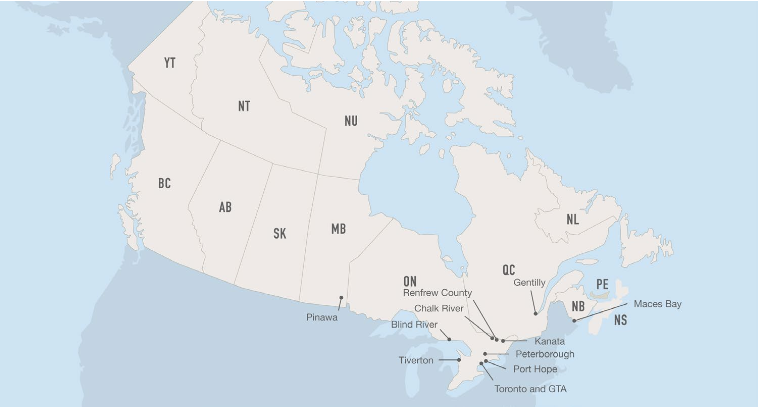
This map depicts the location of the majority of Canada’s current intermediate-level waste. Intermediate-level waste
Intermediate-level radioactive waste is generated primarily from nuclear power plants, research reactors, and medical isotope manufacturers and users, including some medical applications. It consists of components from such areas as the nuclear plant’s purification systems (e.g., filters, resins), the nuclear reactor core (e.g., pressure tubes) and equipment used to support reactor operations (e.g., core detectors).
Intermediate-level waste contains long-lived radionuclides that require hundreds to tens of thousands of years to decay and typically emit high-energy radiation. Unlike high-level waste, it does not generate significant amounts of decay heat. Regardless of its different shapes and sizes, this waste will be disposed of in containers designed to meet rigorous safety standards.
While this waste is currently safely stored on an interim basis at facilities licensed by the Canadian Nuclear Safety Commission (CNSC), it will need to be moved to an underground repository for long-term management. This is considered best international practice.
Non-fuel high-level waste
Non-fuel high-level radioactive waste comes from activities such as production of certain medical isotopes in nuclear facilities. Medical isotopes have various industrial and medical applications such as cancer treatments, medical imaging, or sterilization of single-use medical devices and surgical instruments. There is a very small amount of this waste because advancement in medical isotope production has reduced the amount of waste produced.
This waste generates a significant amount of heat and radioactivity, which requires shielding. While non-fuel high-level waste is currently safely stored on an interim basis at facilities licensed by the CNSC, it will need to be moved to an underground repository for long-term management. This is considered best international practice.
Intermediate- and high-level waste from future reactors
Canada, like other countries around the world, has been called upon to reduce greenhouse gas emissions in order to curb climate change. Because of this, there is significant interest in investing in additional nuclear generation for electricity and industrial applications.
While some new nuclear energy may be generated using existing technology in place at Canada’s nuclear reactors, some may involve other technologies, including large reactors, small modular reactors, micro reactors or advanced reactors not currently used in Canada. These would result in additional radioactive waste.
At this time, the total volume of waste from future nuclear energy expansion projects and new nuclear technologies is not known because these projects are still in development. As more information becomes available, it would be incorporated into our planning and discussed with any interested potential host communities.
- How will radioactive waste be managed
In a deep geological repository
The disposal of intermediate- and high-level radioactive waste in a deep geological repository is considered best international practice from both a technical and a societal perspective. Almost all countries with commercial nuclear power production are planning to isolate their intermediate- and high-level waste in a deep geological repository.
Deep geological repositories are designed to safely isolate radioactive waste from people and the environment in a suitable rock formation. They use a system of multiple barriers, including engineered barriers such as specially designed waste containers and natural barriers such as the rock itself. In Canada and worldwide, the deep geological repository approach to managing radioactive waste is the culmination of more than 40 years of scientific research, development and demonstration of technologies and techniques. For more information about the project, see Appendix A.
We have learned from Indigenous Knowledge Holders to more holistically understand the impacts of our work on rock formations and water. In the context of geoscience, the NWMO’s approach to understanding potential sites has been improved by acknowledging that the cultural significance of these elements is important and can be combined with the findings of western science.
With informed and willing host communities
Community willingness is a key requirement before the NWMO selects a site for a repository for the disposal of this radioactive waste. The process of identifying a suitable site begins with communities expressing interest in learning more about the site selection process and the project. Then, the suitability of those communities will be evaluated through a series of technical and social site evaluations to determine whether the project can be implemented there both safely and in a manner that fosters community well-being. While the NWMO conducts evaluations, communities in turn assess whether the project aligns with their vision and values.
As the process unfolds, the NWMO (from a technical perspective) and the communities (from a well-being perspective) assess whether there is potential for the project to be safe and sustainable in that location, and whether there is potential to work together over the long term. It should be noted that both the NWMO and the communities have a decision-making role in determining whether to proceed to the next activity and ultimately move forward to the regulatory phase. It is the regulators and eventually the federal government that determine whether the project can proceed.
An interested community may include an Indigenous community or a municipal community, and ideally, the expression of a joint interest in which neighbouring communities work together. The project will not proceed without the involvement of Indigenous communities. We commit to adopting an engagement approach that will prioritize engagement with Indigenous communities right from the start of the process. Consistent with Canada’s Policy for Radioactive Waste Management and Decommissioning, and in the spirit of Reconciliation, we acknowledge, respect and honour Indigenous Peoples as rights holders.
Further, we acknowledge that call to action 92 of the Truth and Reconciliation Commission (2015) calls upon the corporate sector in Canada to adopt the United Nations Declaration on the Rights of Indigenous Peoples as a Reconciliation framework and to apply its principles, norms and standards to corporate policy and core operational activities involving Indigenous Peoples and their lands and resources. The NWMO will be guided by Canada’s United Nations Declaration on the Rights of Indigenous Peoples Act (2021), including the requirement for free, prior and informed consent.
In terms of establishing willingness, the NWMO will not dictate how this is done. It will be up to each potential host community to identify the processes and mechanisms they wish to use to demonstrate that the project has the support of community members. We also recognize that the host communities may consist of both Indigenous and municipal communities, and that each have distinct willingness considerations and priorities.
Best practice and recent experience in Canada for siting deep geological repositories suggest there are a range of approaches a community may use in order to achieve this. These include documenting support expressed through open community discussions or town hall meetings, telephone polls, online meetings, surveys, community votes and referenda.
The location and number of potential host communities from which willingness will be required in each siting area will be influenced by the geographic extent of the potential siting area associated with the interested community, as well as geopolitical boundaries, treaty rights and land use.
In a location to be determined
The site selection process will guide us and the communities we work with in finding a location for the second repository. Based on our past engagements with Canadians, Indigenous Peoples, generators of radioactive waste, and waste owners, we propose the process be focused in provinces with a current or prospective interest in nuclear energy.
The waste to be managed could be located:
- In the same location as the first repository (i.e., co-location);
- In a new deep geological repository (the second repository) located somewhere else in a current or prospective nuclear province; or
- In a combination of both scenarios (hybrid).
In each scenario, safety and host community willingness are paramount. Additionally, in any of these three scenarios, it would be necessary to incorporate a plan for expansion to address the need for future intermediate- and high-level waste produced from future nuclear expansion projects and new nuclear reactor technologies.
Co-location with the first repository
The proposed siting process would be open to the communities that we are currently working with to host the first repository. However, while they are welcome to consider expressing interest, this is not required. We remain respectful to our commitments made to those communities — Wabigoon Lake Ojibway Nation and the Township of Ignace — and any change to the scope of that project at the selected site would require the consent of the host communities and approvals by applicable regulatory processes.
If those communities express interest and are willing to host the additional radioactive waste, technical site investigations provide confidence that this additional waste could be safely managed in that location for the long term and regulatory approvals are received, then the waste could be co-located with the first repository.
Co-locating this additional radioactive waste may be possible within the potential expansion capacity of the first repository (with the information that is known to date). Adding this waste would result in an increase in the surface and subsurface size of the repository. This option provides the benefit of using existing surface and subsurface infrastructures and knowledge of the site.
A stand-alone deep geological repository (second repository)
The proposed siting process could result in communities different from the first repository’s host communities hosting this radioactive waste. This option allows for new communities to benefit socially and economically from hosting this new repository.
To ensure Indigenous communities and municipal communities are informed about the project, the NWMO would work collaboratively with them throughout the site selection process. Surface and subsurface investigations would need to be done to confirm the potential of the proposed site to safely and securely contain and isolate the waste.
Once the communities are selected to host the second repository and all required regulatory approvals are received, new surface and subsurface infrastructure would be developed, including such elements as administration, operating and support buildings, and an underground repository.
A hybrid scenario
The communities that have agreed to host the first repository (i.e., Wabigoon Lake Ojibway Nation and the Township of Ignace) may be interested in hosting only some of the additional radioactive waste, in which case both a co-location scenario and a stand-alone scenario may be explored.
Whichever scenario is selected, the NWMO will remain respectful of the commitments we have already made. This includes commitments to Canadians, Indigenous Peoples and the communities hosting the first repository. Community willingness is required before a project is implemented.
- Goals of the proposed process
The site selection process needs to achieve the following goals:
- Finding a site that is safe, secure and sustainable: Recognizing that radioactive waste can remain hazardous for long periods of time, we need to ensure that any site that is selected to host the facility will safely contain and isolate intermediate- and high-level radioactive waste for the long term. The site must be in an appropriate geological formation to ensure long-term safety.
- Finding host communities that are informed and willing: The NWMO will support potentially interested Indigenous and municipal host communities to carefully and thoroughly consider the project’s potential benefits and risks before deciding whether they are willing to host it. We commit to engage local Indigenous communities early in the process. We will not proceed without their involvement and support.
- Fostering ongoing conversations: The NWMO will commit to fostering conversations with Canadians and Indigenous Peoples throughout the process. This includes listening and learning, as well as sharing assessments of health, environmental, social, economic and cultural effects of the project in a transparent manner, and aligned with the NWMO Indigenous Knowledge Policy (2020).
- Helping to demonstrate and reinforce global excellence: We commit to adhere to and help shape international best practices in the field of radioactive waste management and consent-based siting processes.
- Role of third-party review
Consistent with our values, the NWMO will continue to rely on independent reviews and advice throughout the site selection process and beyond, to ensure our activities meet the highest standards of transparency, safety and best available knowledge.
The site selection process will be strengthened by advice from the Council of Elders and Youth, an advisory body to the NWMO that provides counsel on the application of Indigenous Knowledge in our work.
We may also call upon consultants, experts and international collaborators to support and strengthen the numerous technical and social assessments that will be required to assess the suitability of potential sites, and the potential for partnerships in each siting area.
Potential host communities would receive funding to seek independent expert advice during the site selection process, if they choose to do so.
- Glossary
Adaptive Phased Management
Adaptive Phased Management is Canada’s plan for the safe, long-term management of used nuclear fuel. It is both a technical method and a management approach, with an emphasis on adaptability. The end point of the technical method is the centralized containment and isolation of Canada’s used nuclear fuel in a deep geological repository in an area with suitable geology and informed and willing hosts. The management approach involves realistic, manageable phases, each marked by explicit decision points. It allows for flexibility in the pace and manner of implementation and fosters the sustained engagement of people and communities throughout its implementation.
Deep geological repository
A deep geological repository typically consists of a network of underground tunnels and placement rooms for radioactive waste, constructed several hundred metres below the surface, where both natural and engineered barriers contain and isolate it from people and the environment.
Emerging nuclear technologies
If implemented, emerging technologies such as small modular reactors or advanced nuclear reactors will generate additional intermediate- and high-level radioactive waste in Canada. The NWMO is responsible for the long-term management of this additional radioactive waste.
Environment
As defined by the Canadian Nuclear Safety Commission, environment refers to the following components of the Earth:
- Land, water and air, including all layers of the atmosphere;
- All organic and inorganic matter and living organisms; and
- The interacting natural systems that include the above components.
Free, Prior and Informed Consent (FPIC)
From the Institute for Human Rights and Business
- Free: Consent is given voluntarily and absent of coercion, intimidation or manipulation. The process is self-directed by the community from whom consent is being sought unencumbered by coercion, expectations or timelines that are externally imposed.
- Prior: Consent is sought sufficiently in advance of any authorization or commencement of activities.
- Informed: Engagement and type of information that should be provided prior to seeking consent and also as part of the ongoing process. Information should be accessible, clear, consistent, accurate, constant, and transparent, and delivered in appropriate language and culturally appropriate format.
- Consent: Refers to the collective decision made by the rights holders and reached through the customary decision-making processes of the communities.
High-level radioactive waste
This waste generates significant heat via radioactive decay. High-level waste is associated with penetrating radiation, thus requires containment and isolation for hundreds of thousands of years in a deep geological repository. High-level radioactive waste includes mostly used nuclear fuel, but there is a very small amount of non-fuel high-level waste that comes from other activities such as medical isotope production in nuclear facilities.
Intermediate-level radioactive waste
Intermediate-level waste is generated primarily from nuclear power plants, research reactors, and medical isotope manufacturers and users, including some medical applications. It consists of components from such areas as the nuclear plant’s purification systems (e.g., filters, resins), the nuclear reactor core (e.g., pressure tubes) and equipment used to support reactor operations (e.g., core detectors). Intermediate-level waste generally contains long-lived radionuclides in concentrations that require containment and isolation for periods greater than several hundred years. Intermediate-level waste needs no provision, or only limited provision, for heat dissipation during its storage and disposal. Due to its long-lived radionuclides, intermediate-level waste generally requires a higher level of containment and isolation than can be provided in near-surface repositories. Waste in this class may require disposal at greater intermediate depths of the order of tens of metres to a few hundred metres or more.
Low-level radioactive waste
Low-level radioactive waste comes from operating reactors and from medical, academic, industrial and other commercial uses of radioactive materials. Low-level waste contains materials with radionuclide content above established clearance levels and exemption quantities (set out in the Nuclear Substances and Radiation Devices Regulations), but generally has limited amounts of long-lived activity. Low-level waste requires containment and isolation for periods of up to a few hundred years. An engineered near-surface disposal facility is typically appropriate for low-level waste. The responsibility for disposal of low-level radioactive waste resides with the waste owner and waste generator, not with the NWMO.
Non-fuel high-level radioactive waste
Non-fuel high-level radioactive waste comes from activities such as production of certain medical isotopes in nuclear facilities. Medical isotopes have various industrial and medical applications such as cancer treatments, medical imaging, or sterilization of single-use medical devices and surgical instruments. This waste generates a significant amount of heat and radioactivity, which requires shielding and isolation in a deep geological repository. Radionuclide: A type of atom that is unstable and can release energy in the form of radiation as it changes into a different type of atom. They can occur naturally in the environment such as in soil and rocks or are produced as a byproduct of generating electricity in nuclear reactors. Some examples of radionuclides include uranium, radon and carbon-14.
Rights holders
Indigenous Peoples are rights holders and hold collective rights that flow from their continued use and occupation of certain areas. There are inherent rights that Indigenous Peoples have practiced and enjoyed since before European contact. Each First Nation has historically functioned as a distinct society; there is not one official overarching Indigenous definition of what these rights are. These rights are constitutionally protected.
Shielding
Shielding refers to protecting nuclear energy workers, the public or the environment from exposure to the harmful effects of ionizing radiation (a type of energy released by atoms that travel in the form of electromagnetic waves or particles). Shielding is achieved by using barriers such as lead, concrete, rock, depleted uranium, steel or a combination of these materials.
Small modular reactors
Small modular reactors are advanced reactors that produce electricity of up to 300 MW(e) per module, which is less than current power generation reactors.
United Nations Declaration on the Rights of Indigenous Peoples and United Nations Declaration on the Rights of Indigenous Peoples Act
Responding to the Truth and Reconciliation Commission’s Calls to Action 43 and 44, in 2016, the Government of Canada endorsed the United Nations Declaration on the Rights of Indigenous Peoples without qualification and committed to its full and effective implementation. On June 21, 2021, the United Nations Declaration on the Rights of Indigenous Peoples Act received royal assent and immediately came into force. It creates a lasting framework to advance the implementation of the United Nations declaration at the federal level.
Used nuclear fuel
Used nuclear fuel is a byproduct of nuclear power. Used nuclear fuel received at the repository would be a stable solid material sealed in a durable container. In the case of CANDU reactors, it is a solid material sealed in a bundle. Used nuclear fuel is highly radioactive and will remain that way for a long time. It is classified as high-level radioactive waste.
Waste
In the context of this report, waste is assumed to be a radioactive waste, unless specified otherwise (e.g., non-nuclear waste).
Waste generator/producer
The radioactive waste generator/producer is the organization whose operations produce radioactive waste.
Waste owner
The radioactive waste owner is the organization currently responsible for the radioactive waste.
- More details about the project
What are the key components of the project?
Developing and constructing a deep geological repository for the long-term management of radioactive waste is a large and complex project that will be implemented over generations.
The shape and form of the project components depend, in part, on where the project will be located. It may be co-located with a deep geological repository that is being planned for existing used fuel, may be constructed as a stand-alone dedicated repository or may involve a combination of both.
Deep geological repositories typically consist of a network of underground tunnels and placement rooms for radioactive waste several hundred metres below the surface in stable rock formations. Their depth depends on the radioactive waste form, the geological setting and the impact of glacial cycles. They are designed with layers of safety, ensuring the containment system remains inherently safe and intact, even in the unlikely event that one or more components fail.
On the surface or above ground, the deep geological repository could include administrative buildings; buildings to support the receipt, handling and packaging of the radioactive waste; a ramp and headframes, hoisting and shafts buildings to access the underground repository; and support facilities such as a water treatment plant and an excavated rock management area.
Below ground, access tunnels leading to a network of engineered placement rooms would be constructed for the disposal of the radioactive waste in disposal-ready containers. We expect that the intermediate- and high-level radioactive waste placement rooms would be separate to accommodate their unique geometries and radiological characteristics.
The radioactive waste would be monitored throughout all phases of the project, and the waste is expected to be retrievable up to the completion of the monitoring phase and closure of the deep geological repository. The access tunnels and shafts would be sealed only when regulatory conditions are satisfied.
A strong safety case must be developed that demonstrates with confidence that the project can be safely implemented at the designated site. The project must meet all applicable regulatory standards and requirements for protecting the health, safety and security of people; protecting the environment, including water and waterways; and respecting Canada’s international commitments on the peaceful use of nuclear energy.
How will the radioactive waste be transported to the selected site?
The process of transporting the radioactive wastes described in this document will follow well-established requirements and standards laid out by federal regulatory authorities such as Transport Canada and the Canadian Nuclear Safety Commission (CNSC). The transport of radioactive materials in Canada is governed by the Packaging and Transport of Nuclear Substances Regulations and Transportation of Dangerous Goods Regulations that are based on internationally accepted standards.
In fact, radioactive waste has been safely transported in Canada, particularly in Ontario, for several decades without any radioactive material being released into the environment. This equates to several thousands of shipments over millions of kilometres.
Intermediate- and high-level radioactive wastes are transported in specially designed transportation packages. As a requirement, the packages must have been subject to tests in which they survived and retained their content under accident conditions. This is to ensure the safety of the public and the environment, including the protection of water. These accident conditions include a series of severe tests, including drops from height, a water immersion test and a fire test. As well, the design, testing, manufacturing and quality assurance program for these transportation packages are reviewed by the CNSC. Once the CNSC is satisfied that transportation regulatory requirements are met, it will issue a package design certificate of approval for the use of these packages in the public domain. These transportation packages are also required to be inspected and maintained on a regular basis and are subject to CNSC re-certification.
Transport Canada’s regulations require that additional transport requirements be met such as shipping documentation, safety marks, training and emergency management before a shipment of radioactive material can occur in the public domain.
While the transportation program would not begin until the second repository is operational, likely in several decades, the NWMO recognizes it is a subject of broad public interest. We understand the dialogue around waste transportation is a priority for many Indigenous communities, and we are committed to listening to their concerns and perspectives. Early planning and engagement with Indigenous and municipal communities is essential to ensure their perspectives are considered in the transportation planning process.
What is the cost of the project?
The eventual cost of this project depends on the volumes of radioactive waste generated, the location of the site, how the nuclear landscape evolves in Canada, and other factors. Estimates will consider what costs can reasonably be expected to occur over the many decades of the project, along with a contingency for unexpected events.
Costs would include the various phases of the project, including pre-siting, siting and detailed characterization, regulatory reviews, design, construction, operations, transportation, and the decommissioning and closing of the repository. There could be cost advantages to the co-location scenario, as efficiencies from the first repository would be built in.
The NWMO will work towards determining the potential project cost range for these scenarios over the next several years and revise them, as necessary, as future reactors, nuclear energy expansion projects and new nuclear technologies come on stream.
Nuclear waste owners are currently setting aside funds to cover the costs of radioactive waste disposal through various methods, including segregated funds and trust funds.
How will the project be funded?
Funds required to cover the full cost for disposal of these wastes in a deep geological repository will be borne by nuclear waste owners and generators. It is specified in the Government of Canada’s modernized Policy for Radioactive Waste Management and Decommissioning that waste owners and generators are responsible for funding and developing plans for the disposal of radioactive waste.
Oversight and regulation of radioactive waste management and decommissioning is the responsibility of the CNSC. As mandated under the Nuclear Safety and Control Act, the CNSC requires waste producers to provide financial guarantees to cover the cost (in present value terms) associated with interim storage, decommissioning and the long-term management of radioactive waste produced to date.
The guaranteed funds are reviewed independently by the CNSC as part of the waste owner licence requirements and are satisfied by segregated funds or other guaranteed financial instruments.
This same requirement, to set aside funds for disposal, would be applicable for new or small nuclear waste owners (e.g., small modular reactors, micro reactors) and producers of any future radioactive waste that is produced in Canada. The NWMO is committed to working with new or small nuclear waste owners and producers to ensure that the costs associated with the disposal of their intermediate- and high-level waste is reflected in their financial guarantees to the CNSC.
What is the expected timing of this project?
Timing will depend on many factors and will evolve as more information about future nuclear projects becomes available. Construction of the deep geological repository will only start after willingness of the host communities is established, and after the appropriate regulatory and environmental approvals have been received. Thus, it is not expected to begin until at least the late 2040s. Figure A1 below shows a preliminary timeline.
Figure A1: This is a proposed timeline for the project. Accepting the responsibility for intermediate-level and non-fuel high-level waste October 2023 Canada's Minister of Energy and Natural Resources accepts the recommendations of the Integrated Strategy for Radioactive Waste. Developing the siting process 2024-27 The NWMO develops a proposed siting process and conducts public engagement activities before finalizing the process. Identifying a site using the siting process 2028-mid-2030s The site selection process is initiated.
Site characterization, preliminary design and narrowing down process advance.
The NWMO selects a site for the repository.
Towards construction Late 2030s-50s The NWMO submits the project description.
Further characterization and detailed design are undertaken.
Regulatory decision-making takes place.
Constructionbegins. operations begin.
While planning and implementing a large project includes adhering to schedules and timelines, we understand that meaningful, collaborative work requires careful consideration, patience, open-mindedness and humility.
Will the deep geological repository be monitored?
There will be an extensive environmental and operational monitoring program for ground and surface water, radiation, air quality and more. Monitoring will start prior to construction and will continue through operations and beyond. There will also be an extended monitoring period following placement of the waste to ensure the repository is performing as expected.