The NWMO worked in collaboration with Indigenous and municipal communities to assess suitability of potential candidate sites for the first repository for more than a decade. This has allowed us to develop world-class assessment approaches and expertise in integrating both technical and community well-being assessments, including opportunities to align with Indigenous Knowledge and learnings. Our proposed site selection approach for the second repository builds on these approaches.
The proposed process is designed to be flexible and adaptive. The activities are intended as a navigation aid to help communities in planning and visualizing how the process could play out, rather than as a precise process. There could be cases in which preparatory and planning work for an activity will be initiated by the NWMO or interested community prior to formal initiation of that activity. Individual communities may also be at different points in the process at any given time. Some activities may also be completed at a faster pace, depending on past involvement of the community with the first repository.
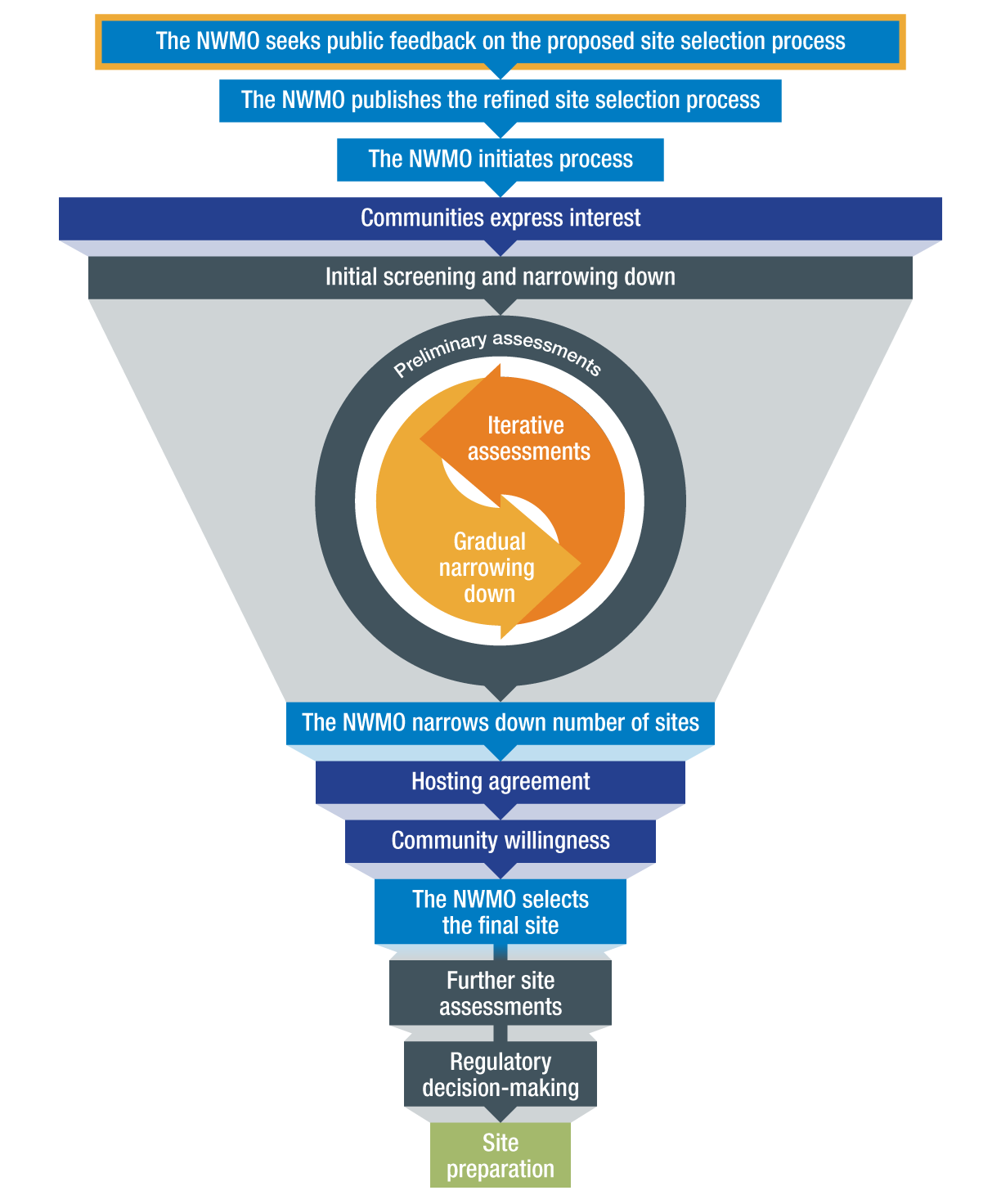
The process starts with communities expressing interest in learning more about the project. It will then involve an initial screening, followed by a series of iterative technical and social assessments to narrow down the number of interested communities. The level of detail and the duration of each activity will depend on the siting scenario being considered and the amount of available information for each potential siting area, as well as the interests, needs and preferences of the interested Indigenous and municipal communities. A high-level timeline is provided in the project information to help communities with planning.
We know that working with Indigenous Peoples, aligning with Indigenous Knowledge, applying what we have learned from past experiences, and honouring these learnings throughout the assessments in accordance with our Indigenous Knowledge Policy (2020) are critical elements of the process. We will seek opportunities to co-develop and work with Indigenous Peoples to ensure local Indigenous Knowledge and land use is part of assessments; opportunities are provided for communities’ participation in field studies; ceremonies and offerings led by communities may be conducted prior to fieldwork; cultural training for contractors is provided prior to fieldwork; and assessment findings are shared with the communities.
The NWMO will continue to listen and learn as we go, refining practices, maintaining flexibility, and adapting to new social inputs and regulations as they emerge.
Site selection process at a glance
Site selection process
Pre-site selection
- Public dialogues to refine the proposed site selection process
The NWMO actively engages in dialogues with Canadians and Indigenous Peoples, and a wide range of interested parties, to seek feedback and ideas about the proposed site selection process. Engagement on the proposed site selection process, focused in current and prospective nuclear provinces, is achieved through a variety of engagement tools and activities such as in-person and virtual presentations, one-on-one and group discussions, online comments and webinars.
At the end of the engagement period, the NWMO publishes the site selection process, informed by the public feedback received.
Note: The second repository project is now in this public dialogue stage. Your feedback on this platform will help confirm and refine our final site selection process.
Site selection
- The NWMO initiates the site selection process
The NWMO initiates the siting process with a program of information and engagement activities designed to help build awareness and understanding of the NWMO, the types of radioactive waste involved, the project, and the goals, principles and activities in the site selection process.
The NWMO launches an inclusive and comprehensive outreach program to provide information and respond to requests for information. The program focuses its outreach activities with Indigenous Peoples, municipalities, the broad public, individuals and organizations located in provinces with existing or prospective nuclear projects, and others interested in learning more about the project and the site selection process. The information shared in the outreach program is posted on the NWMO website for broad public access and review. Activities of this nature are expected to continue throughout the site selection process and in parallel with subsequent activities.
- Communities express their interest in learning more and entering the process
Communities express interest in learning more about the process. For the purpose of expressing interest, “community” is defined as a political entity that has the mandate to speak for a community or group of communities. This could include an Indigenous community, a municipality, a township, a county or a combination of these.
Requests to learn more must be made with the support of accountable authorities (e.g., elected representative bodies). This may involve an existing Indigenous government, the municipal council of a community, a new group established by a community involving community leaders, or other group as deemed appropriate by the community. It is important to note that ultimately the project would not proceed without the involvement of Indigenous Peoples. The NWMO from the beginning works with the communities expressing interest to engage Indigenous and municipal communities in the vicinity of the siting area to build awareness of the site selection process and the project in order to build collaborative, sustainable and resilient relationships.
- An initial screening assessment is conducted, and the NWMO provides detailed briefing
The objective of this activity is to quickly assess whether the project has the potential to be feasible in that location. The NWMO evaluates the conditions of the potential location against a list of initial screening criteria, including Indigenous community interest. The evaluations are based on readily available information, including Indigenous Knowledge. Communities evaluate their interest in remaining in the process based on their learning and capacity-building plan, supported by the NWMO. Communities not meeting all initial screening criteria will be excluded from further consideration.
Communities that do not see any potential for alignment with the project may choose to exit the process. The communities not excluded by the initial screening decide whether they are interested in continuing to the next activity in the site selection process (i.e., preliminary assessments). These communities could get access to resources in the form of funding and information to support learning and capacity-building activities such as:
- Seeking independent expert advice;
- Aligning with Indigenous Knowledge;
- Building relationships with local communities (e.g., Indigenous/municipal) in the vicinity of the siting area;
- Augmenting or developing a long-term vision for sustainability;
- Learning about the project; and
- Conducting engagement activities to inform residents and assess interest in hosting the project in their community.
The nature of resources provided will be outlined in a short-term agreement between the community and the NWMO.
- Preliminary assessments: Iterative technical and social assessments, and narrowing down process
At the request of interested communities successfully passing the initial screening, the NWMO begins, in collaboration with those communities, a series of preliminary assessments.
The objective is to determine: (1) whether the project can be safely located at the site, (2) whether the project suits the community and (3) whether there is potential for long-term collaboration.
Preliminary assessments explore the following technical and social aspects:
- Safety: The site must be able to safely contain and isolate the waste in a manner that will protect people and the environment, including water and waterways, over the very long term. The gradual narrowing down is completed through:
- Desktop studies: Technical desktop studies involve geoscientific, environmental and engineering feasibility studies based on the interpretation of readily available information.
- Field studies for remaining communities: This includes additional technical site evaluations involving geoscientific and environmental field investigations, as well as application of Indigenous Knowledge and the involvement of Indigenous community members. The nature and duration of technical studies and field investigations will be site specific depending on available site information and the number of communities still in the process.
- Community well-being: The site must be located in an area where the project can be implemented in a way that supports the quality of life of the local communities as they themselves define it. This includes both Indigenous and municipal communities. Communities create or express a vision for the future with and without the project. They agree on and either lead or participate in studies to evaluate community well-being based on continued learning and capacity-building plans. Communities establish methods to evaluate or manage changes that may occur (positive and negative) as a result of the project. They receive input on whether to proceed to the next phase of the process (a hosting agreement). Communities agree on and design a decision-making model to express willingness.
- Long-term collaboration with communities: The site must be located in an area where strong and resilient relationships can be developed with Indigenous and municipal communities and the NWMO in the siting area.
Depending on the number of communities passing the initial screening, there may be a comparative analysis, and the NWMO may prioritize communities for preliminary assessments according to their potential. Meanwhile, communities themselves assess the potential of the project to align with their own principles and values, and decide whether the project is good for them.
The preliminary assessments serve to gradually narrow down the number of communities with strong potential to meet the technical and social requirements of the project, to those where there is strong potential for the communities and the NWMO to collaborate in the long term.
The various assessments will be collaboratively planned and conducted in discussion with Indigenous and municipal communities. The NWMO seeks opportunities to align with Indigenous Knowledge in the assessments, consistent with our Indigenous Knowledge Policy (2020).
A comprehensive learning and engagement program is collaboratively designed and implemented by the NWMO and interested communities to build awareness of the project and explore the potential for building resilient relationships in communities and surrounding areas. This is important because the project will be implemented over many decades and will require community relationships that can stand the test of time.
The cost of these types of activities is covered by the NWMO.
The first few communities that can successfully meet the safety and social requirements move to the next activity. Communities with lower potential to meet the technical and social requirements are gradually removed from the site selection process during this phase until only a few sites with strong potential are identified.
- Safety: The site must be able to safely contain and isolate the waste in a manner that will protect people and the environment, including water and waterways, over the very long term. The gradual narrowing down is completed through:
- Hosting agreement
The NWMO and the selected communities develop and sign mutually agreeable hosting agreements, subject to community willingness and regulatory approvals. Hosting agreements detail the commitments made by the NWMO and the communities should the site be selected, and set out roles and expectations on working collaboratively as they move forward together into the regulatory process.
- Potential host communities demonstrate willingness
Potential host communities demonstrate their willingness to accept the project and the terms of the hosting agreement. It will be up to each potential host community to identify the processes and mechanisms it wishes to use to demonstrate its willingness to host the project in a manner that meets the specific needs of the community and to also demonstrate clearly to the NWMO whether the project has the support of community members.
- The NWMO selects a preferred site
The NWMO selects a preferred site that meets the safety and social requirements. The selected site must have confirmed willingness of local siting communities, including Indigenous Peoples in whose territory the facility will be built.
Post-site selection
- Additional site assessments
For the selected site, building on the work completed in the preliminary assessments, the NWMO initiates additional site assessments to confirm the suitability of the site and prepares the necessary supporting documentation to initiate the regulatory decision-making process for the site. The NWMO continues to collaborate with the communities in the siting areas and continues to align with Indigenous Knowledge to collaboratively plan and conduct the technical studies for a co-development approach.
- Regulatory decision-making
Regulatory authorities review the safety of the project through an independent, formal and public stepwise regulatory process. The implementation of the project will be regulated under the Nuclear Safety and Control Act and its associated regulations to protect the health, safety and security of the public and the environment, and to respect Canada’s international commitments on the peaceful use of nuclear energy.
Once all regulatory requirements are satisfied, the NWMO is given a series of successive approvals to proceed in a stepwise manner through site preparation, construction, operations, decommissioning and closure. Local and Indigenous-owned businesses will be given opportunities to support the project, driving further community economic development.
- Site preparation, construction, operations, decommissioning and closure
This step involves site preparation, construction, operations, decommissioning and closure of the required repository surface and underground facilities. Operations will begin after an operating licence is obtained from regulatory authorities. The NWMO will continue to work with the host communities to ensure commitments to the communities are addressed throughout the entire lifetime of the project.